What is Ascension Day?
Ascension Day commemorates the ascent of Jesus into heaven, forty days after the resurrection, as told in the Acts of the Apostles and the Gospels of Mark and Luke. According to Acts, Jesus appeared to the apostles over a period of forty days and was then taken up into a cloud while they watched. The feast marks the end of the appearances of the risen Jesus and prepares for Pentecost, ten days later. In the Western church it always falls on a Thursday, although the Catholic Church allows some countries to move it to the following Sunday. In 2027 it falls on 6 May in the West and on 10 June in the Orthodox churches.
In Germany the day is also known as Vatertag or Männertag, a men's day when groups go hiking with wagons and drinks, a secular custom that has grown alongside the religious one. In many countries, such as Belgium, France, the Netherlands, Austria and the Nordic states, it is a long-weekend holiday, and in a number of Catholic regions, processions with blessings of the fields and crops are held. Because it is a Thursday, many people take the Friday off as well, producing a four-day weekend. Church services are held in the morning.
Why it is observed
The feast of the Ascension is one of the oldest festivals of the Christian year. Eusebius seems to hint at it in the fourth century, and Augustine, writing in the early fifth, describes it as of apostolic origin and observed throughout the Catholic Church. The number of days follows the Acts account of forty days between resurrection and ascension, and because Easter always falls on a Sunday, Ascension always falls on a Thursday. The three Rogation days before it, with prayers for the harvest, gave the festival many agricultural customs in northern Europe. The Orthodox date follows the Julian Easter, so it usually falls one, four or five weeks after the Western date.
How the date is set
Ascension Day falls 39 days after Easter Sunday, on the Thursday of the sixth week of Easter, which is the fortieth day of Eastertide when Easter Sunday counts as day one. On the Western calendar it ranges from 30 April to 3 June. Orthodox churches follow the Julian calculation, so their date is later.
How it is observed
Ascension Day is a public holiday in the site's data in Austria, Belgium, Denmark, Finland, France, Germany, Iceland, Liechtenstein, Luxembourg, the Netherlands, Norway, Sweden, Switzerland and Monaco, among others, including Indonesia and, on a Monday, Colombia. In many places the Friday after it is taken off as a bridge day. Banks, offices and most shops are closed, and roads and trains are busy with leisure travel. The date moves each year with Easter. Pay, bridge days and substitute arrangements depend on the country and the contract. Check each year's date, because Ascension moves from late April to early June.
Sources
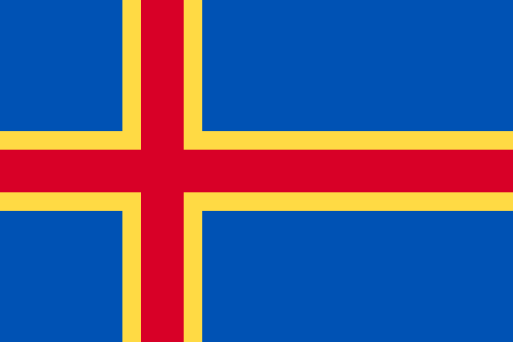 Åland Islands
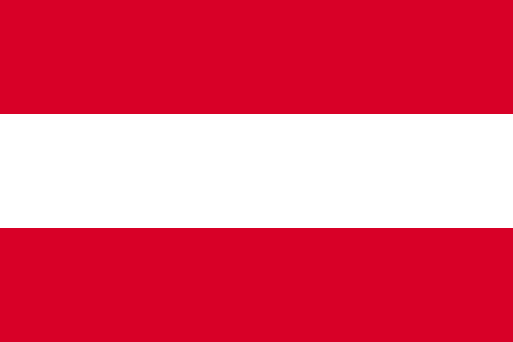 Austria
 Belgium
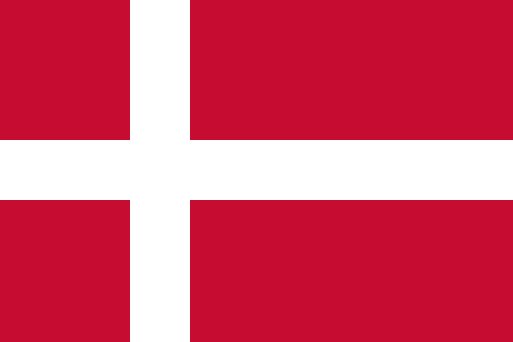 Denmark
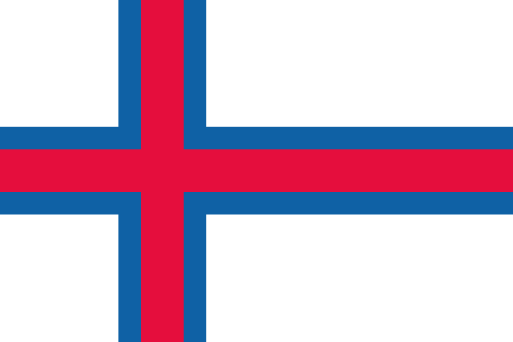 Faroe Islands
 Finland
 France
 Germany
 Iceland
 Liechtenstein
 Luxembourg
 Monaco
 Netherlands
 Norway
 Svalbard & Jan Mayen
 Sweden
 Switzerland
 Vatican City