What is Assumption Day?
Assumption Day celebrates the Catholic belief that Mary, the mother of Jesus, was taken body and soul into heavenly glory at the end of her earthly life. The doctrine was defined as dogma by Pope Pius XII on 1 November 1950 in the apostolic constitution Munificentissimus Deus, although the feast and the belief are much older. It is one of the major Marian feasts and a holy day of obligation in many Catholic countries.
In Italy the holiday is Ferragosto, the heart of the summer break, when cities empty and families head to the seaside or the mountains. In France, Spain, Poland, Austria, Croatia, Portugal and elsewhere there are church services and processions, and in Poland and several other countries herbs and flowers are blessed on the day; the Polish feast is known as Matki Boskiej Zielnej, Our Lady of the Herbs. The date falls in the middle of the summer holiday season, which gives it a social as well as a religious role.
Why it is observed
A feast of Mary's death and entry into heaven was kept in Jerusalem in the fifth century, with the Armenian lectionary of about 434 already placing a Marian feast on 15 August. In the East it came to be called the Dormition, the falling asleep. By the seventh century the feast was observed in Rome, where the emphasis moved to the Assumption. Ferragosto comes from the Latin Feriae Augusti, a rest period established by the Emperor Augustus in 18 BC, which the Christian feast later overlapped with. The doctrine itself was not defined until 1950.
How the date is set
Assumption Day is fixed on 15 August. Orthodox churches keep the same feast as the Dormition of the Mother of God on 15 August by the Revised Julian calendar, which is 28 August in the civil calendar for churches that still use the Julian calendar.
How it is observed
Assumption Day is a public holiday in Andorra, Austria, Belgium, Spain, France, Croatia, Italy, Lithuania, Luxembourg, Monaco, Poland, Portugal, Slovenia, San Marino and the Vatican, among others, and in parts of Germany. Shops, banks and offices close, though restaurants and shops in tourist areas often stay open. Because it falls in the peak holiday period, trains and roads are crowded, especially in Italy and France. Orthodox countries observe the same feast as the Dormition. In 2027 15 August is a Sunday, and some countries, such as Spain, move the day off to Monday 16 August. Pay and substitute days depend on the country and the contract.
Sources
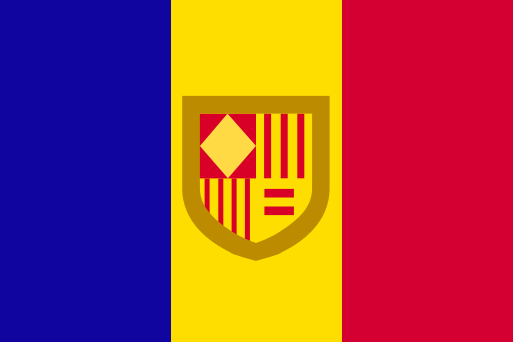 Andorra
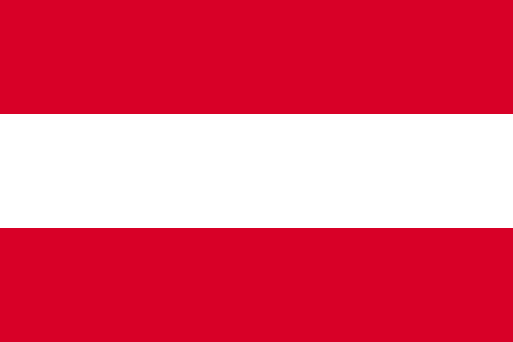 Austria
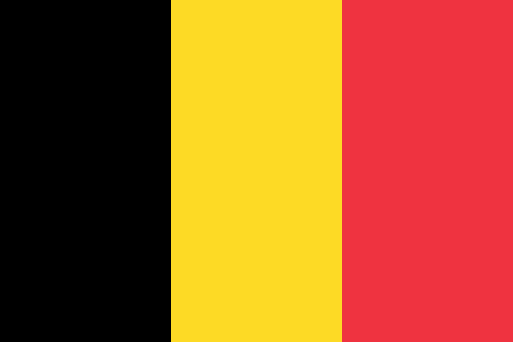 Belgium
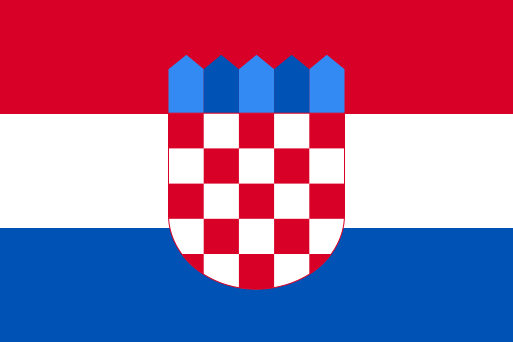 Croatia
 France
 Italy
Italy Lithuania
 Luxembourg
 Monaco
 Poland
 Portugal
 San Marino
 Slovenia
 Vatican City