What is Candlemas?
Candlemas is the Christian feast of the Presentation of Jesus in the Temple, which is described in the Gospel of Luke. According to Luke, forty days after his birth, Mary and Joseph brought the infant Jesus to the temple in Jerusalem, in keeping with Jewish law, and there Simeon and the prophetess Anna recognised him. In the Catholic Church the feast is also called the Purification of Mary. The feast is known in the Eastern churches as the Meeting of the Lord, from the meeting of Simeon with the child.
The name Candlemas comes from the blessing of candles that takes place on the day, a ritual that symbolises Christ as the light of the world, and is associated with Simeon's words that he would be a light to the Gentiles. In many Catholic regions, candles for the year are blessed in church, and in France the day is called La Chandeleur and is marked by making crêpes, which are said to bring luck if flipped with a coin in the hand. The German-language name is Mariä Lichtmess. The feast is also called Candle Day.
Why it is observed
The feast is known from the fourth century in Jerusalem, where it was kept on 14 February, forty days after Epiphany on 6 January, and it moved to 2 February when Christmas was fixed on 25 December. The candle procession was added in Rome around the seventh century. In German-speaking rural society, Candlemas was traditionally the day on which servants and farm workers could change employers, and it marked the end of the Christmas season in many places. The weather lore of the day is also the origin of the American Groundhog Day, which falls on the same date.
How the date is set
Candlemas is fixed on 2 February, forty days after Christmas Day. The Orthodox Meeting of the Lord is kept on the same day in churches using the revised calendar.
How it is observed
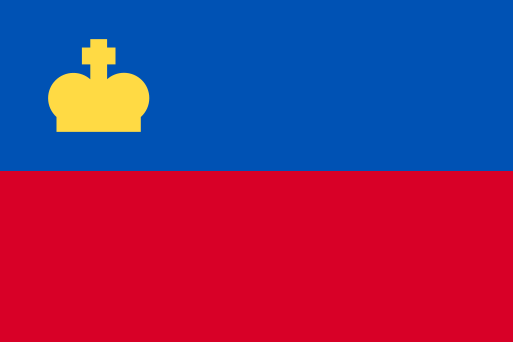
Candlemas is a public holiday in Liechtenstein on 2 February. Banks, offices, schools and most shops close, and church services include the blessing of candles. In most other countries it is a normal working day, even where it is celebrated in church. In France, crêpes are eaten on 2 February though it is not a holiday. Pay and time off depend on the country and the contract, and the details should be checked locally. Where the feast is not a holiday, it is observed with morning or evening services and the blessing of candles in many churches, and in France with family meals.
 Liechtenstein