What is Corpus Christi?
Corpus Christi, Latin for the Body of Christ, is a Catholic feast celebrating the real presence of Christ in the Eucharist. It is kept on the Thursday after Trinity Sunday, and in many countries it is marked by outdoor processions in which the consecrated host is carried through towns in a monstrance, often under a canopy, with flower petals strewn along the route. In some countries the procession and the observance are moved to the following Sunday.
Among the best-known customs are flower carpets laid along the processional route, a tradition in places such as La Orotava in Tenerife and Sitges in Spain, Genzano in Italy and parts of Germany and Poland. In Poland the day, Boże Ciało, is one of the most widely observed religious holidays; in German-speaking regions it is Fronleichnam, and in parts of Bavaria and Austria marksmen's companies fire salutes during the procession. The mood is festive, since the feast celebrates the Eucharist rather than the Passion.
Why it is observed
The feast was extended to the whole Western church in 1264 by Pope Urban IV in the bull Transiturus de hoc mundo, after decades of promotion that began with the visions of Juliana of Liège, a nun in what is now Belgium, and a local feast in the diocese of Liège from 1246. The Eucharistic miracle of Bolsena is often cited as a spur, though historians consider the tradition problematic. Thomas Aquinas is credited with composing the liturgical office. The feast was slow to spread after Urban's death and gained wider observance in the fourteenth century, together with the processions. Protestant churches did not adopt it.
How the date is set
Corpus Christi falls on the Thursday after Trinity Sunday, 60 days after Easter Sunday (27 May in 2027). On the Western calendar it ranges from 21 May to 24 June. Some countries move the observance to the following Sunday.
How it is observed
Corpus Christi is a public holiday in Austria, Croatia, Liechtenstein, Monaco, Poland, Portugal and San Marino, among others, and in parts of Germany and Switzerland depending on state and canton. In Italy it is not a public holiday and the church celebration is held on the Sunday. Where it is a holiday, shops and offices close and many people take the Friday as a bridge day. In 2027 it falls on 27 May. Pay and substitute days depend on the country and the contract.
Sources
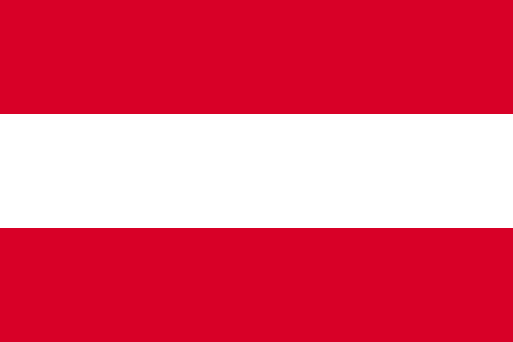 Austria
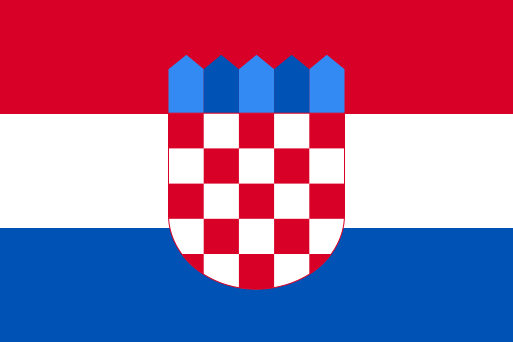 Croatia
 Liechtenstein
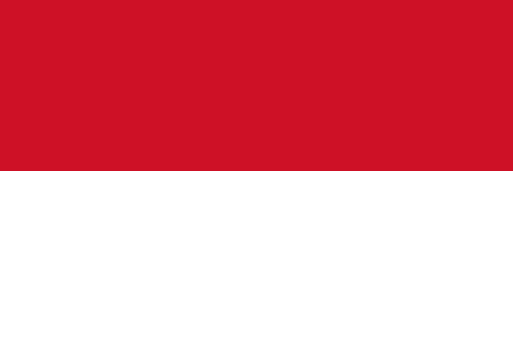 Monaco
 Poland
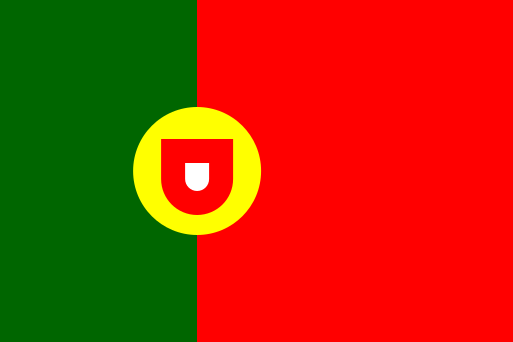 Portugal
 San Marino