What is Defender of the Fatherland Day?
Defender of the Fatherland Day is a Russian holiday on 23 February that honours the armed forces and military veterans and, in practice, all men. It is observed with ceremonies at memorials, concerts, and military and school events. In the Soviet Union the day was known as Soviet Army and Navy Day, and the older name is still sometimes used in conversation. Greetings on the day are given to men in uniform as well as to relatives and colleagues.
In everyday Russian life the day has become a kind of men's day, the counterpart of International Women's Day on 8 March. Women give men, whether or not they have served, small gifts, cards and flowers, and workplaces mark the day with small celebrations. The same date is observed in Belarus, Kyrgyzstan and Tajikistan, in different forms. Kazakhstan's Defender of the Fatherland Day is a separate holiday on 7 May, in the calendar used on this site. Schools hold concerts and sports events.
Why it is observed
The holiday goes back to 1919, when 23 February was first celebrated as Red Army Day. In Soviet tradition the date commemorated the mass enlistment of volunteers and the decree founding the Red Army in February 1918, although the date was in fact chosen for the 1919 anniversary. It was later renamed Soviet Army and Navy Day, and in Russia today it is Defender of the Fatherland Day. In Russia, 23 February was declared a non-working day for the first time in 2002, under the new Labour Code.
How the date is set
Defender of the Fatherland Day is fixed on 23 February. It has been a non-working public holiday in Russia since 2002. Kazakhstan's day with this name is on 7 May.
How it is observed
In Russia, 23 February is a non-working public holiday, with banks, public offices and schools closed, and florists and gift shops are especially busy beforehand. When it falls on a weekend, the government may move a day off to another date, so the exact days off should be checked each year; in 2027 it is a Tuesday. Public transport runs a holiday schedule. Pay and time off depend on Russian labour law and the contract.
Sources
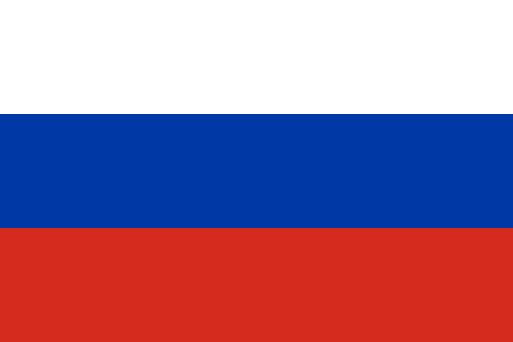 Russia