What is Good Friday?
Good Friday commemorates the crucifixion of Jesus at Calvary and his death. It is the most sombre day in the Christian calendar and the centre of Holy Week, between Maundy Thursday and Holy Saturday. Catholic and Protestant churches hold services of readings, prayers and veneration of the cross, often at three in the afternoon, and many believers fast or abstain from meat. In the Orthodox churches it is called Great and Holy Friday, the Divine Liturgy is not celebrated, and the evening service features the procession of the epitaphios, a cloth icon that represents Christ's burial. Whatever the denomination, the day's mood is subdued.
The name uses an older sense of good meaning pious or holy; the folk explanation that it refers to the good outcome of the Passion is not accepted. In Old English the day was called Long Friday, and equivalents survive in the Scandinavian languages and Finnish. Customs include processions in Spain, Italy, Malta and Portugal, hot cross buns in Britain, fish dishes in many countries, and in some Protestant countries a strong tradition of quiet, with legal limits on public dancing and similar events. In Spain and Italy the processions with hooded penitents are the best-known sight, and in Jerusalem pilgrims walk the Via Dolorosa.
Why it is observed
The commemoration of Christ's death on the Friday before Easter goes back to the earliest centuries of Christianity. The long Holy Week liturgies were developed further in Jerusalem in the fourth century, where pilgrims, among them the traveller Egeria, followed the places of the events. After the Reformation Protestant countries kept the day as one of the main holy days, and in Germany, Scandinavia and the United Kingdom it remains a statutory holiday today, often with rules about dancing, sport and public events. Because the Orthodox churches calculate Easter on the Julian calendar, their Good Friday is on a different date in most years: in 2027 Western Good Friday is 26 March and Orthodox Good Friday 30 April.
How the date is set
Good Friday is the Friday before Easter Sunday, two days before it. Western churches reckon it on the Gregorian calendar, which gives a date between 20 March and 23 April, and Orthodox churches reckon it on the Julian calendar, which currently gives a date between 2 April and 6 May.
How it is observed
Good Friday is a public holiday in most of Europe, in Canada, Australia and other Commonwealth countries, and in Latin America, but it is not a federal holiday in the United States. France recognises it only in Alsace-Moselle, and in some countries, Austria and Belgium among them, it is a day off for banks but not for shops. In Germany, public dancing and some other events are restricted by law. In Orthodox countries such as Romania, Bulgaria, Greece, Cyprus, Serbia, Georgia, Ethiopia and Eritrea the Orthodox date applies. Pay and entitlements depend on the country and the contract. Visitors should check shop hours in advance.
Sources
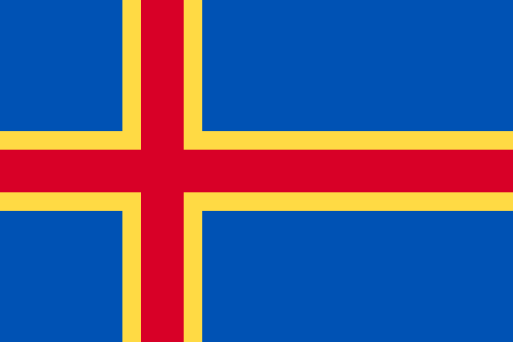 Åland Islands
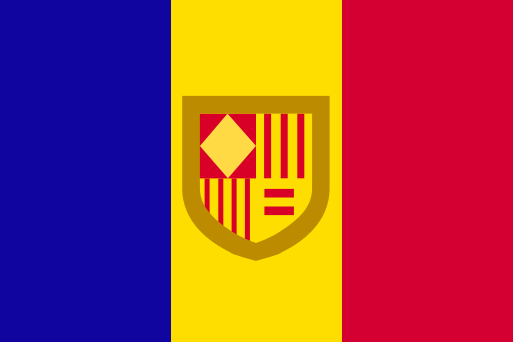 Andorra
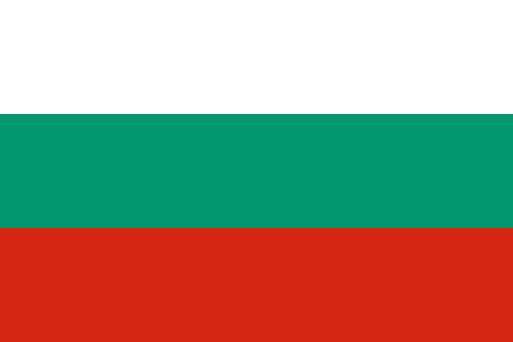 Bulgaria
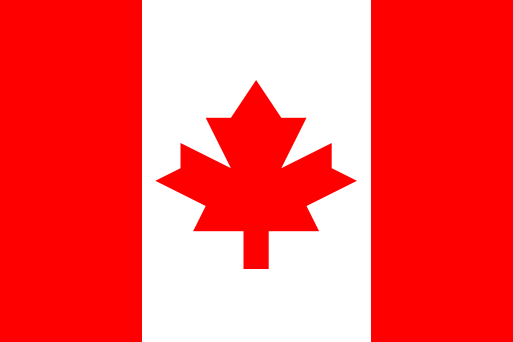 Canada
 Cyprus
 Czechia
 Denmark
 Estonia
 Faroe Islands
 Finland
 Germany
 Gibraltar
 Greece
 Guernsey
 Hungary
 Iceland
 Isle of Man
 Jersey
 Latvia
 Malta
Malta Netherlands
 Norway
 Portugal
 Romania
 Serbia
 Slovakia
 Spain
Spain Svalbard & Jan Mayen
 Sweden
 United Kingdom
 Vatican City