What is Immaculate Conception?
The Immaculate Conception is a Catholic feast celebrating the belief that Mary, the mother of Jesus, was preserved from original sin from the moment of her conception. It is often confused with the conception of Jesus, which is the Annunciation, kept on 25 March. The doctrine was defined as dogma by Pope Pius IX on 8 December 1854 in the bull Ineffabilis Deus. Conception here refers to Mary's own conception by her mother, Saint Anne.
The Immaculate Conception is the patron of Spain and Spanish infantry, and the day brings processions and flower offerings to statues of Mary in Spain and Italy. In Seville, boys known as Los Seises dance before the altar of the cathedral during the feast. In Rome the pope visits the Column of the Immaculate Conception near the Spanish Steps each 8 December, a custom since 1953, after the fire brigade has placed a wreath on the statue of Mary. In Italy and elsewhere the day is also seen as the start of the Christmas season, when trees and lights go up.
Why it is observed
The feast began in the East in the seventh century and was kept in England and elsewhere in the West from the eleventh century, but for a long time it was disputed by theologians, since figures such as Thomas Aquinas doubted that it could be reconciled with the universal need for redemption. Franciscan thinkers, above all Duns Scotus in the early fourteenth century, answered the objection. Pope Sixtus IV approved a Mass and office in 1477, Clement XI made it a holy day of obligation for the whole church in 1708, and Pius IX defined the dogma in 1854. The date is nine months before the traditional birthday of Mary on 8 September.
How the date is set
The Immaculate Conception is fixed on 8 December, nine months before the feast of the Nativity of Mary on 8 September.
How it is observed
The Immaculate Conception is a public holiday in Andorra, Austria, Spain, Italy, Liechtenstein, Monaco, Portugal, San Marino and the Vatican, and in several Latin American countries such as Argentina, Chile, Colombia and Peru. Malta lists it as the Feast of the Immaculate Conception. Shops and offices close, though in Austria and Italy the day is a customary shopping day at the start of the Christmas season, and opening rules vary by place. In Spain it often forms a puente, a bridge weekend, with Constitution Day on 6 December. In 2027 it falls on a Wednesday. Pay and substitute days depend on the country and the contract.
Sources
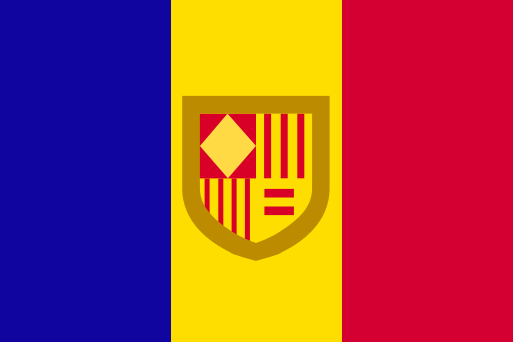 Andorra
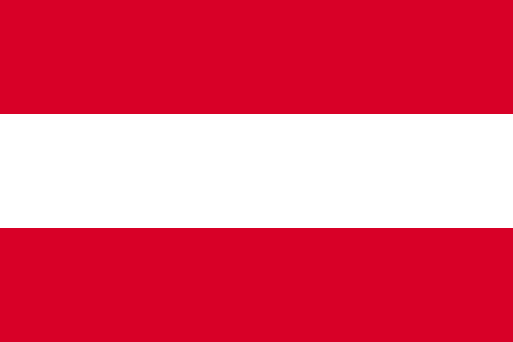 Austria
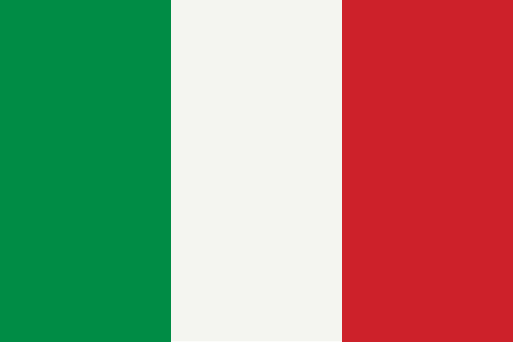 Italy
Italy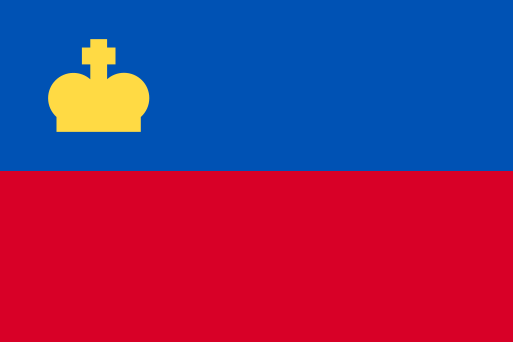 Liechtenstein
 Monaco
 Portugal
 San Marino
 Spain
Spain Vatican City