What is Labor Day?
Labor Day, or Labour Day, honours workers and the labour movement, but the name is used for two different calendar traditions. In the United States and Canada it is the first Monday of September and marks the unofficial end of summer, with parades, picnics, and back-to-school preparations. In much of Europe the same idea goes by the name of International Workers' Day and takes place on 1 May. The two meanings of the name sometimes cause confusion for international readers, since the same word refers to different dates. In both versions the idea is the same: to honour workers.
The countries on this site that use the name Labor Day for 1 May include Greece, Montenegro, Serbia and Slovenia, where the day is also a time for trade union marches and for outings in the countryside. In North America, the September date means that the holiday does not coincide with May Day, and it has a more neutral, family-oriented character. In both countries it is widely seen as the end of the summer holiday season, and many schools and universities begin their autumn term shortly afterwards. Ontario and Quebec, among other provinces, also mark it as a statutory holiday.
Why it is observed
The North American holiday began in the 1880s. The first Labor Day parade was held in New York City on 5 September 1882, organised by the Central Labor Union, and the idea spread, with Oregon becoming the first state to make it an official holiday in 1887. Congress made it a federal holiday in 1894, in the aftermath of the Pullman strike. Canada had held labour parades earlier, notably in Toronto in 1872 in support of striking printers, and Parliament made the first Monday of September a national holiday in 1894. The date was deliberately chosen to be distinct from the international May Day.
How the date is set
The date depends on the country. In the United States and Canada, Labor Day is the first Monday of September. In Greece, Montenegro, Serbia and Slovenia it is 1 May, sometimes with 2 May as well, and in Greece it is moved when 1 May falls during the Orthodox Easter period.
How it is observed
In the United States and Canada, Labor Day is a long weekend on which banks, public offices, schools and many shops close, and highways and airports are busy as people take a final summer trip. Many retailers hold sales. In Greece, Montenegro, Serbia and Slovenia, the 1 May holiday follows European practice, with closures and demonstrations. Entitlements to extra pay or substitute days depend on the country, the sector and the individual contract. Check the country-specific page for the exact date. Where the holiday falls on a Monday, as in North America, it creates a three-day weekend that is one of the busiest for road travel and for end-of-season sales.
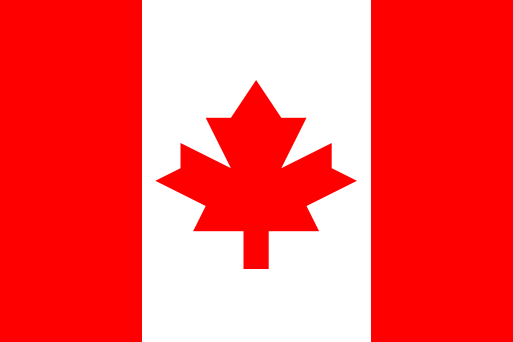 Canada
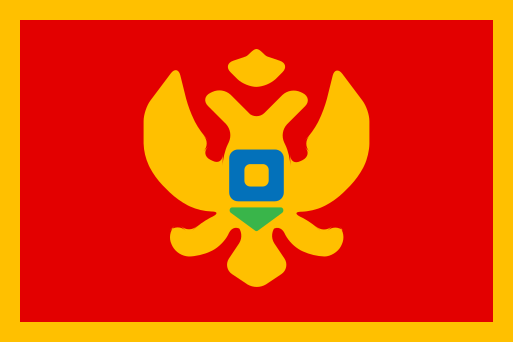 Montenegro
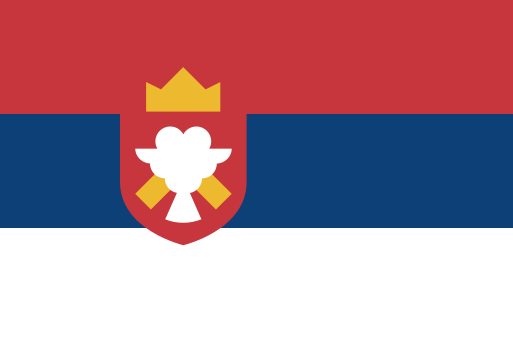 Serbia
 Slovenia
 United States