What is National Day?
National Day is a generic name, and the holiday it describes differs in each country. France celebrates on 14 July, which recalls the storming of the Bastille in 1789 and the Fête de la Fédération of 1790; Spain on 12 October, the Fiesta Nacional de España, tied to the arrival of Columbus in the Americas in 1492 and declared by a 1987 law; Switzerland on 1 August, which refers to the Federal Charter traditionally dated to 1291; and Austria on 26 October, the anniversary of the 1955 constitutional law on Austrian neutrality, celebrated as National Day since 1965.
Belgium observes its National Day on 21 July, the day in 1831 when Leopold I took the oath as first king of the Belgians. Hungary has two days listed under this name, 15 March for the revolution of 1848 and 23 October for the uprising of 1956. In the United Arab Emirates National Day on 2 December marks the 1971 union of the emirates. The parades, concerts, flag displays and fireworks that typify many of these days are far from universal, so the date, meaning and customs must be checked for each country.
Why it is observed
The idea of a single national holiday is mostly modern. It grew in the eighteenth and nineteenth centuries as states built national identities, and many countries chose a day linked to a founding event, a constitution or a ruler. Some dates were set deliberately and not by history. Luxembourg's National Day, 23 June, began as a celebration of the sovereign's birthday that moved with each reign; a Grand Ducal decree of 1961 fixed it on 23 June, reportedly because the weather is better than in January, the birthday of Grand Duchess Charlotte. Because every date reflects its own history, the same label covers events that have little in common.
How the date is set
There is no single date. National Day is a general name for the day a country marks its nationhood, and the date and the event behind it depend entirely on the country. Some countries use a fixed calendar date, and others tie it to a historical event such as a revolution, a constitution or a monarch's birthday.
How it is observed
Where National Day is a public holiday, banks, offices and schools are closed, and there are usually official ceremonies, military parades or fireworks in the capital, which can mean road closures and crowds. The 14 July military parade on the Champs-Élysées is among the best known. Some countries move the day when it falls on a weekend and others do not. In 2027 the dates include 14 July in France, 21 July in Belgium and 26 October in Austria. Extra pay and time off depend on the country, the sector and the contract.
Sources
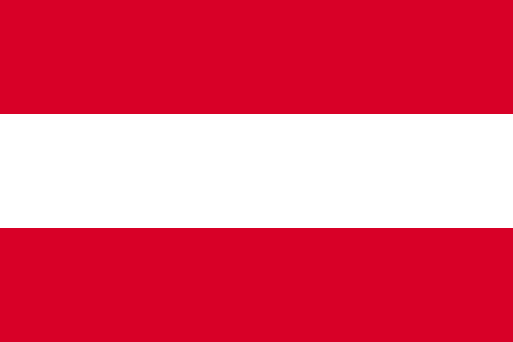 Austria
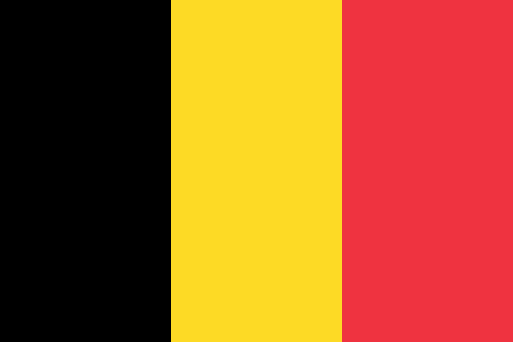 Belgium
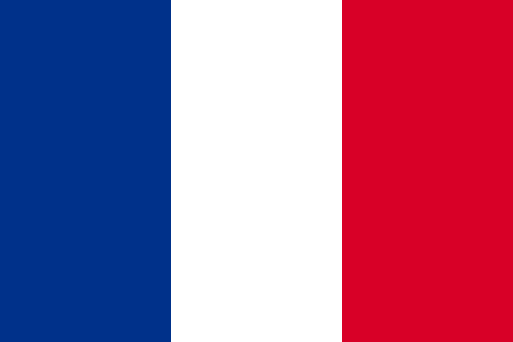 France
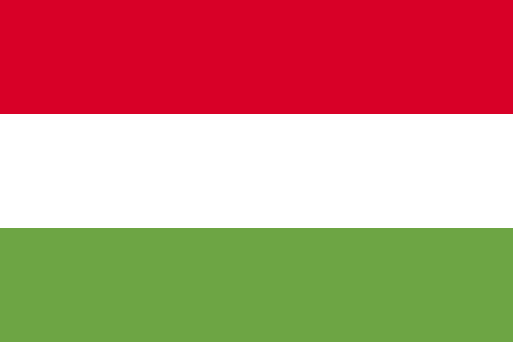 Hungary
 Iceland
 Liechtenstein
 Luxembourg
 Poland
 Romania
 Spain
Spain Sweden
 Switzerland