What is Reformation Day?
Reformation Day commemorates the beginning of the Protestant Reformation in 1517, when the German monk and theologian Martin Luther sent out his Ninety-five Theses, a set of arguments against the sale of indulgences and other church practices. It is a major day for Lutheran and other Protestant churches, marked with special services and the singing of Luther's hymn A Mighty Fortress Is Our God. It carries special weight in eastern Germany, where Wittenberg, Eisleben and Erfurt are important Luther sites, and church concerts are a common feature.
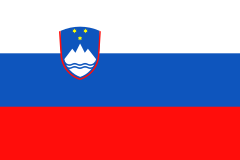
In Slovenia, 31 October is a public holiday that honours the Reformation's contribution to Slovene culture and in particular Primož Trubar, the Protestant reformer whose Catechism and Abecedarium, printed in 1550, were the first books in the Slovene language. Chile also keeps the day as a national holiday, as the Day of the Evangelical and Protestant Churches. In Germany it is a public holiday only in some states. Elsewhere in German-speaking Europe it is a church observance, and many congregations hold evening services.
Why it is observed
Tradition holds that Luther posted the Ninety-five Theses on the door of the Castle Church in Wittenberg on 31 October 1517. Historians debate whether the posting took place in that form, but 31 October 1517 is the date on which Luther sent the theses to Archbishop Albert of Brandenburg, and the text was soon widely printed. In Slovenia the Reformation of the sixteenth century helped establish the written Slovene language, which gives the day a national and cultural meaning beyond the religious one, and the day has been a public holiday there since the early 1990s. In Germany it was a one-off holiday in all states in 2017, for the 500th anniversary.
How the date is set
Reformation Day is fixed on 31 October. It is observed on that date wherever it is a holiday and is not moved.
How it is observed
Reformation Day is a public holiday in Slovenia, and in Germany in the states of Brandenburg, Mecklenburg-Western Pomerania, Saxony, Saxony-Anhalt and Thuringia, and, since 2018, Bremen, Hamburg, Lower Saxony and Schleswig-Holstein. In those places banks, offices and schools close and most shops are shut. In the rest of Germany it is a normal working day. In 2027 31 October falls on a Sunday, so there is no extra day off. Pay and time off depend on the state or country and the contract.
Sources
 Slovenia