What is Pentecost Monday?
Pentecost Monday is the day after Pentecost Sunday and the second day of the Pentecost festival. In German-speaking countries it is Pfingstmontag, in France Lundi de Pentecôte, in the Netherlands Tweede Pinksterdag, and in English-speaking countries it was traditionally called Whit Monday. In Orthodox countries, such as Greece, it is known as the Monday of the Holy Spirit. The Monday has a long tradition in Central and Western Europe, where it is regularly used for pilgrimages and fairs. It is also known as the Second Day of Pentecost. It is observed with local customs.
For most people the holiday is a spring day off, used for family excursions, hikes, fairs and regional folk events. In Cyprus it is the day of the Kataklysmos, the Festival of the Flood, when people gather at the seaside and take part in water games and music. In Germany, the Netherlands and Belgium many people travel in the long weekend that begins at Pentecost, and in several regions traditions such as fairs and processions are held. The date is also a major day for excursions, regional markets and open-air music events, and in parts of Germany and Austria, traditional Pentecost riding festivals take place.
Why it is observed
Whit Monday has been a holiday in many parts of Europe since the Middle Ages, when the festivities of Pentecost were extended over several days. In England it became a bank holiday under the Bank Holidays Act 1871. In 1971, the Banking and Financial Dealings Act replaced the movable Whit Monday bank holiday with a fixed Spring Bank Holiday on the last Monday in May. Cyprus's Kataklysmos is tied to the Flood narrative in Genesis and is celebrated at the end of the Pentecost feast. In Orthodox countries the Monday is dedicated to the Holy Spirit.
How the date is set
Pentecost Monday is the day after Pentecost, which is the fiftieth day of Easter counted with Easter Sunday as day one. It falls 50 days after Easter Sunday, between 11 May and 14 June on the Western calendar, and later in Orthodox countries.
How it is observed
Pentecost Monday is a public holiday in many European countries, including Austria, Belgium, Denmark, France, Germany, Greece, Hungary, Luxembourg, the Netherlands, Norway and Switzerland, among others. In France it is officially a day of solidarity, and employers may ask staff to work, while in most countries banks, offices and schools close. Because the date moves with Easter, travel and accommodation can be busy and expensive. Pay and substitute days depend on the country, the sector and the contract. Shops that remain open are usually in tourist areas. Confirm the exact date locally each year.
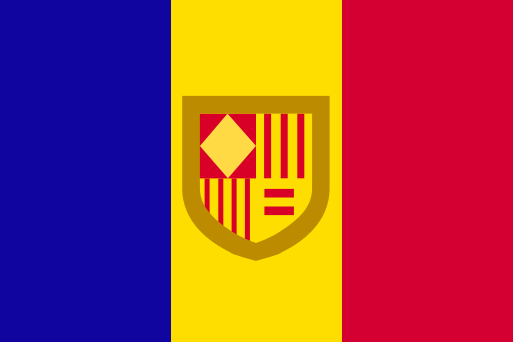 Andorra
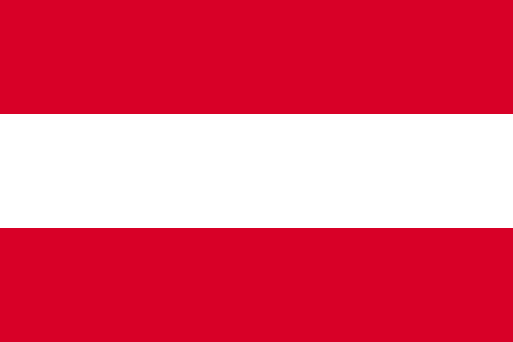 Austria
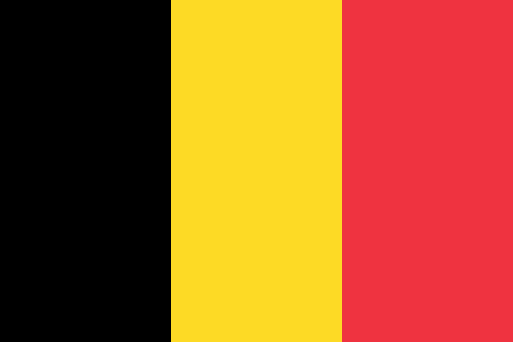 Belgium
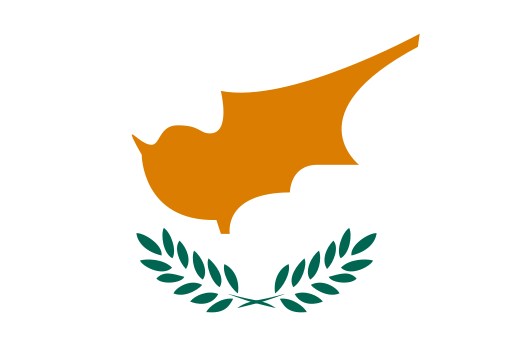 Cyprus
 Denmark
 Faroe Islands
 France
 Germany
 Greece
 Hungary
 Iceland
 Liechtenstein
 Luxembourg
 Monaco
 Netherlands
 Norway
 Svalbard & Jan Mayen